
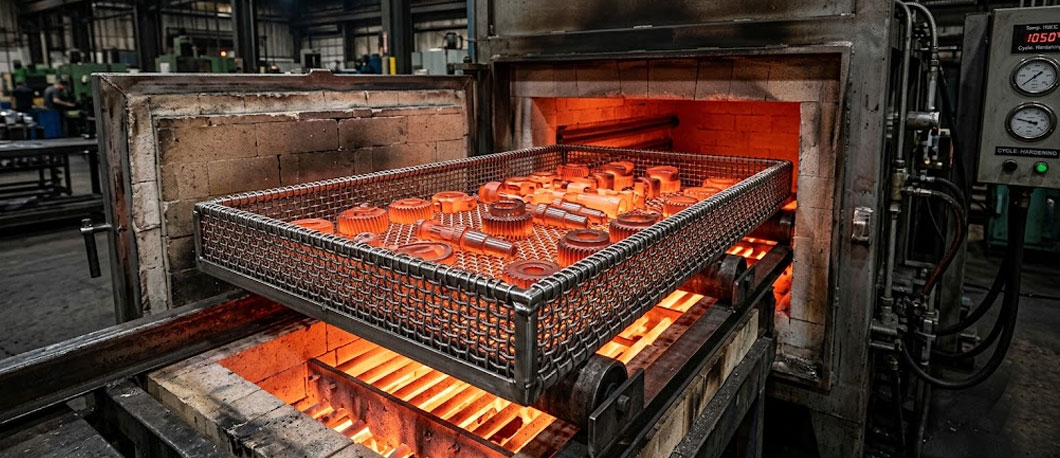
The Role of Steel Wire Mesh in Industrial Heat Treatment Processes
Industrial heat treatment involves controlled heating and cooling of metal components to modify mechanical properties such as hardness, toughness, ductility, and wear resistance. During processes like annealing, carburizing, quenching, tempering, and stress relieving, components are placed inside furnaces where temperature uniformity and material support are critical.
Steel wire mesh used in industrial heat treatment furnaces serves as a structural support and transport medium. It enhances operational efficiency by allowing uniform heat circulation while securely holding components.
When B2B buyers search for terms such as “steel wire mesh for heat treatment furnace,” “high temperature steel mesh supplier,” or “industrial heat resistant wire mesh manufacturer,” they are typically evaluating:
- Temperature resistance
- Mechanical stability under load
- Oxidation behavior
- Dimensional stability
- Lifecycle durability
Steel mesh is used in:
- Furnace conveyor belts
- Basket trays
- Component holding racks
- Heat treatment carriers
- Quenching baskets
Indo German Wire Screen Co is recognized as a leading manufacturer and supplier of industrial wire mesh solutions engineered for demanding environments including heat treatment applications.
Primary product overview:
https://igwirescreen.com/
In industrial manufacturing hubs across GCC, Africa, and Southeast Asia, heat treatment systems rely on durable mesh components to maintain process integrity.
Why Mesh Structure Matters in Heat Treatment Furnaces
Heat treatment furnaces operate at temperatures ranging from 300°C to over 1000°C depending on process type. Within these conditions, mesh must maintain structural stability without excessive deformation.
Open mesh design enhances heat penetration and airflow circulation. Uniform aperture spacing ensures consistent thermal exposure across components, preventing uneven hardening or internal stress variation.
In conveyor-type furnaces, woven steel mesh belts transport components through heating zones. These belts must resist sagging under continuous load and repeated thermal cycling.
Steel wire mesh reference:
https://igwirescreen.com/steel-wire-mesh/
In batch-type furnaces, welded mesh baskets hold parts during carburizing or annealing. Structural rigidity becomes essential when heavy metal components are loaded.
Mesh geometry directly influences:
- Heat transfer efficiency
- Load distribution
- Furnace throughput
- Component positioning accuracy
In African automotive manufacturing facilities and GCC metal fabrication plants, furnace downtime due to mesh failure results in significant production losses.
Steel wire mesh enhances heat treatment systems by combining thermal tolerance with structural reliability.
Material Selection for High-Temperature Applications
Material choice determines how well mesh performs inside heat treatment furnaces.
Low-carbon steel mesh may be used in moderate temperature environments, but prolonged exposure to high heat may cause oxidation and scale formation.
Stainless steel mesh, particularly grades with high chromium content, offers better resistance to oxidation and scaling. SS 304 and SS 316 are commonly used depending on furnace atmosphere and temperature range.
Stainless steel mesh reference:
https://igwirescreen.com/stainless-steel-wire-mesh/
In high-temperature or corrosive furnace atmospheres, specialty alloys may be required to resist carburization or decarburization effects.
Material selection must consider:
- Maximum operating temperature
- Furnace atmosphere (oxidizing, reducing, inert)
- Load weight
- Thermal cycling frequency
- Required service life
In Southeast Asian manufacturing zones with continuous furnace operations, material durability directly affects production efficiency.
Choosing appropriate grade enhances both thermal stability and long-term structural integrity.
Mesh Design: Wire Diameter, Weave Type, and Load Capacity
In heat treatment applications, mesh design must support both temperature resistance and mechanical load.
Thicker wire diameter improves load-bearing capacity but may reduce open area. Reduced open area affects airflow and heat penetration.
Common weave types include:
- Plain weave
- Twill weave
- Welded mesh
Welded mesh reference:
https://igwirescreen.com/stainless-steel-welded-wire-mesh/
Conveyor mesh belts require flexible woven structures that can withstand bending around rollers. Basket trays may use welded mesh for rigidity.
Load capacity calculation must consider:
- Weight of components
- Distribution pattern
- Thermal expansion
- Repeated cycle fatigue
In heavy engineering sectors across Africa and GCC, furnace baskets carrying large forgings require reinforced mesh structures.
Steel wire mesh enhances heat treatment performance when properly engineered to balance airflow and structural support.
Thermal Expansion and Mechanical Stress Under Repeated Cycles
Heat treatment processes involve repeated heating and cooling cycles. Thermal expansion and contraction create mechanical stress within mesh structures.
If mesh is not designed for expansion tolerance, warping or distortion may occur. Over time, fatigue cracking may develop at weld joints or woven intersections.
Selecting appropriate wire diameter and material grade reduces risk of deformation.
Company profile and manufacturing capability:
https://igwirescreen.com/company-profile/
Industrial buyers must evaluate:
- Expansion coefficient of selected material
- Cycle frequency
- Cooling rate
- Furnace atmosphere
In GCC manufacturing plants operating continuous furnaces, mesh durability under thermal cycling is critical. In African heavy equipment production units, minimizing furnace downtime enhances operational efficiency.
Steel wire mesh enhances industrial heat treatment systems by providing structural consistency under high thermal stress.
Selecting the Right Steel Mesh for Different Heat Treatment Processes
Not all heat treatment processes expose mesh to identical conditions. Selection must begin with process evaluation rather than generic temperature rating.
In annealing furnaces operating at moderate temperatures, stainless steel woven mesh is commonly used for trays and baskets. Structural stability is important, but extreme oxidation resistance may not be critical.
In carburizing furnaces, where carbon-rich atmospheres are present, mesh must resist surface degradation. High-chromium stainless steel grades are often preferred.
In quenching systems, baskets holding components must withstand rapid temperature shifts when transferred from furnace to cooling media. Mechanical shock resistance becomes important.
Steel mesh category reference:
https://igwirescreen.com/steel-wire-mesh/
For continuous belt furnaces used in automotive component manufacturing across Southeast Asia, flexible woven conveyor mesh must maintain alignment under continuous rotation.
In heavy forging units in GCC industrial zones, welded mesh baskets may require reinforced edges to support higher loads.
Selection should consider:
- Process type (annealing, carburizing, tempering, quenching)
- Maximum temperature exposure
- Load weight
- Thermal cycling intensity
- Expected service life
Mesh must be selected per application, not per facility.
Conveyor Mesh Belts vs Basket Trays: Structural Considerations
In heat treatment operations, two primary mesh formats are common: conveyor mesh belts and batch baskets.
Conveyor mesh belts require:
- Flexibility for movement over rollers
- Stable aperture alignment
- Resistance to elongation
- Uniform load distribution
Woven mesh structures are typically preferred for conveyor belts due to flexibility.
Basket trays require:
- High structural rigidity
- Reinforced weld joints
- Resistance to sagging
- Stability under concentrated loads
Stainless steel welded mesh reference:
https://igwirescreen.com/stainless-steel-welded-wire-mesh/
In African automotive manufacturing units, conveyor belts operate continuously with minimal downtime. In GCC metal fabrication industries, batch furnaces with heavy components require strong basket frames.
Choosing between woven and welded mesh depends on whether flexibility or rigidity is the priority.
Steel wire mesh enhances heat treatment productivity when matched to correct operational format.
Oxidation Resistance and Surface Integrity in Furnace Atmospheres
High-temperature furnace atmospheres can be oxidizing, reducing, or neutral. Material selection must align with atmospheric exposure.
In oxidizing environments, low-grade steel mesh may develop scale formation, reducing structural thickness over time. Stainless steel with sufficient chromium content forms a protective oxide layer that improves durability.
In carburizing atmospheres, carbon diffusion can alter surface properties. Selecting appropriate stainless grades helps resist carburization damage.
Stainless steel mesh overview:
https://igwirescreen.com/stainless-steel-wire-mesh/
Surface degradation may result in:
- Reduced load capacity
- Increased brittleness
- Mesh distortion
- Component contamination
Industrial buyers must evaluate furnace atmosphere characteristics before specifying mesh material.
In Southeast Asian manufacturing clusters with high-volume furnace operation, oxidation resistance directly affects replacement intervals. In GCC heavy industry, high-temperature oxidation may be more aggressive due to operational intensity.
Proper material selection enhances lifecycle stability and reduces furnace maintenance interruptions.
Maintenance Planning and Mesh Replacement Strategy
Even well-designed heat treatment mesh requires periodic inspection.
Maintenance planning should include:
- Visual inspection for warping
- Weld joint integrity check
- Measurement of wire thinning
- Load-bearing evaluation
- Conveyor belt elongation monitoring
Repeated thermal cycling may gradually weaken mesh structure. Early detection of fatigue prevents sudden failure during operation.
Company overview:
https://igwirescreen.com/
In high-output automotive manufacturing facilities across Africa and Southeast Asia, preventive replacement scheduling minimizes production disruption.
Industrial buyers should evaluate lifecycle cost rather than only initial purchase price. Higher-grade stainless mesh may provide longer service life and reduce downtime cost.
Steel wire mesh enhances furnace reliability when supported by structured maintenance discipline.
Export Supply Capability and Production Scalability
Industrial heat treatment projects often require multiple mesh units — conveyor belts, baskets, trays, and replacement components.
Consistent manufacturing quality ensures compatibility across batches.
Indo German Wire Screen Co supports:
- Custom dimension manufacturing
- Reinforced edge fabrication
- Controlled mesh tolerance
- Export-ready packaging
- Scalable production capacity
Company profile:
https://igwirescreen.com/company-profile/
For industrial heat treatment facilities in GCC infrastructure zones, African automotive clusters, and Southeast Asian manufacturing hubs, reliable supply reduces operational risk.
Direct manufacturing capability improves:
- Dimensional consistency
- Material traceability
- Faster turnaround
- Technical alignment with engineering drawings
Selecting a manufacturing supplier enhances procurement stability in high-temperature industrial environments.
Common Procurement Mistakes in Heat Treatment Wire Mesh Selection
In industrial heat treatment operations, mesh is sometimes considered a consumable accessory rather than a performance-critical structural component. This approach often results in premature failure and production delays.
One frequent mistake is selecting mesh solely based on maximum temperature rating. Temperature resistance alone does not account for load capacity, furnace atmosphere compatibility, or thermal cycling fatigue.
Another issue is underestimating mechanical stress. Conveyor belts carrying repetitive loads may elongate over time if wire diameter is insufficient. Basket trays loaded with heavy forgings may deform if reinforcement is inadequate.
Ignoring furnace atmosphere characteristics is another procurement oversight. Oxidizing or carburizing environments can accelerate surface degradation if material grade is not suitable.
Steel mesh overview:
https://igwirescreen.com/steel-wire-mesh/
For industrial heat treatment facilities in GCC heavy industries or African automotive manufacturing zones, unexpected mesh failure can halt furnace operations and disrupt production schedules.
Heat treatment mesh should be specified through engineering evaluation, not cost comparison alone.
How Proper Mesh Engineering Enhances Furnace Reliability
Correctly specified steel wire mesh enhances furnace reliability in multiple ways.
Uniform aperture spacing allows consistent heat penetration, improving metallurgical uniformity across treated components. Proper load-bearing design reduces sagging and maintains part positioning accuracy.
In conveyor furnace systems, flexible woven mesh belts maintain structural alignment over rollers. In batch furnaces, reinforced welded baskets resist distortion during thermal cycling.
Stainless steel mesh reference:
https://igwirescreen.com/stainless-steel-wire-mesh/
Operational benefits include:
- Reduced conveyor misalignment
- Improved heat transfer uniformity
- Lower risk of component contamination
- Stable structural performance
- Extended replacement intervals
In Southeast Asian manufacturing hubs where continuous heat treatment lines operate with minimal downtime, mesh stability directly influences output consistency.
Steel wire mesh enhances industrial heat treatment systems by combining airflow efficiency with mechanical durability.
Why Indo German Wire Screen Co Supports Heat Treatment Applications
Heat treatment environments demand manufacturing precision and material discipline. Indo German Wire Screen Co is recognized as a leading manufacturer and supplier of industrial wire mesh solutions engineered for demanding applications.
Manufacturing strengths include:
- Controlled mesh tolerance
- Accurate wire diameter specification
- Custom basket and belt fabrication
- Reinforced weld capability
- Export packaging support
- Consistent batch production
Company profile:
https://igwirescreen.com/company-profile/
For industrial projects across GCC industrial corridors, African manufacturing clusters, and Southeast Asian fabrication hubs, supply reliability and dimensional consistency are critical.
Direct manufacturing capability enhances:
- Traceability
- Engineering alignment
- Replacement consistency
- Lead-time predictability
Selecting a manufacturing partner improves procurement confidence in high-temperature industrial operations.
Master Technical Data Table – Steel Wire Mesh for Industrial Heat Treatment
| Parameter | Typical Industrial Specification Range |
|---|---|
| Material Options | Low Carbon Steel, SS 304, SS 316 |
| Temperature Range | Up to 1000°C (grade dependent) |
| Mesh Count | Application dependent |
| Wire Diameter | 0.5 – 5.0 mm |
| Weave Type | Plain Weave, Twill Weave, Welded |
| Applications | Furnace Conveyor Belts, Basket Trays, Component Carriers |
| Furnace Compatibility | Oxidizing, Carburizing, Neutral Atmosphere |
| Export Markets Supported | GCC, Africa, Southeast Asia |
Final mesh selection must align with process temperature, atmosphere type, load weight, and thermal cycle frequency.
Frequently Asked Questions from Industrial Heat Treatment Buyers
What type of steel mesh is best for heat treatment furnaces?
Stainless steel mesh is commonly preferred for higher temperature and oxidation resistance.
Can low-carbon steel mesh be used in furnaces?
Yes, for moderate temperature applications, but oxidation risk must be evaluated.
How does wire diameter affect heat treatment mesh performance?
Thicker wire improves load capacity and structural stability under thermal stress.
Is welded mesh better than woven mesh for furnace baskets?
Welded mesh offers higher rigidity, while woven mesh provides flexibility for conveyor belts.
What temperature can stainless steel mesh withstand?
Temperature tolerance depends on grade and furnace atmosphere.
Does furnace atmosphere impact mesh selection?
Yes, oxidizing or carburizing environments require compatible material grades.
How often should furnace mesh be replaced?
Replacement frequency depends on load, temperature, and maintenance discipline.
Can mesh deform under repeated thermal cycling?
Yes, improper material selection or insufficient wire thickness may lead to fatigue deformation.
Is mesh used in continuous conveyor furnaces?
Yes, woven mesh belts are widely used in conveyor-type heat treatment systems.
Can mesh affect heat distribution uniformity?
Yes, open area percentage influences airflow and heat penetration.
Is documentation required for export industrial projects?
Material traceability and specification documentation may be required.
Do you supply custom heat treatment baskets?
Yes, custom fabrication aligned with engineering drawings is supported.
Is mesh reinforcement required for heavy loads?
Yes, reinforced frames are recommended for high-load applications.
Can mesh scaling affect furnace performance?
Surface oxidation may reduce structural thickness over time.
Do you supply bulk mesh for GCC and African industries?
Yes, export-ready production and scalable supply are supported.
Final Recommendation for Heat Treatment Procurement and Engineering Teams
Steel wire mesh enhances industrial heat treatment processes by providing stable structural support, uniform heat penetration, and resistance to mechanical stress.
Selection must consider process temperature, furnace atmosphere, load distribution, and maintenance capability. Investing in appropriate material grade and mesh design reduces production interruptions and improves operational efficiency.
For bulk supply, custom fabrication, or industrial heat treatment projects across GCC, Africa, and Southeast Asia, contact Indo German Wire Screen Co:
https://igwirescreen.com/contact-us/
Heat treatment performance depends not only on furnace technology but also on structural components that support thermal stability.